Loading...
Searching...
No Matches
GPIO Public APIs
Functions | |
| void | gpio_init (GPIO_CFG_ts *gpio_cfg) |
| Initializes a GPIO pin according to the given configuration. | |
| void | gpio_deinit (GPIO_REGDEF_ts const *gpio_port) |
| Deinitializes a GPIO port by resetting its registers to reset values. | |
| void | gpio_write (GPIO_REGDEF_ts *gpio_port, uint8_t gpio_pin, PIN_STATUS_te pin_status) |
| Drives a GPIO output pin high or low. | |
| PIN_STATUS_te | gpio_read (GPIO_REGDEF_ts const *gpio_port, uint8_t gpio_pin) |
| Reads the current logic level of a GPIO input pin. | |
| void | gpio_clear_interrupt (EXTI_LINES_te exti_line) |
| Clears the EXTI pending flag for the given interrupt line. | |
| void | gpio_get_name (GPIO_REGDEF_ts const *gpio_port, char *name) |
| Returns the name string of a GPIO port. | |
Detailed Description
Function Documentation
◆ gpio_init()
| void gpio_init | ( | GPIO_CFG_ts * | gpio_cfg | ) |
Initializes a GPIO pin according to the given configuration.
- See also
- gpio_init
Definition at line 29 of file stm32f401re_gpio.c.
29 {
30 // Enable the clock for the GPIO peripheral
32
33 // Configure GPIO output type
36
37 // Configure GPIO speed
40
41 // Configure GPIO pull-up pull-down
44
45 // Configure GPIO alternate function (2 bits per pin in AFR[0] for pins 0-7, AFR[1] for pins 8-15)
48
51
52 // Configure GPIO mode
56 }
57 else {
58 // Enable the peripheral clock for SYSCFG
59 RCC->RCC_APB2ENR |= (0b1 << 14);
60
61 // Route the GPIO pin to the EXTI line via SYSCFG_EXTICRx
65 }
69 }
73 }
74 else {
77 }
78
79 // Unmask the EXTI line for this pin
81
82 // Configure edge trigger
86 break;
89 break;
93 break;
94 }
95
96 // Enable the corresponding NVIC interrupt line
97 uint8_t exti_position = get_exti_position(gpio_cfg);
99 }
100}
void nvic_set_interrupt(IRQn_te interrupt_line, EN_STATUS_te en_status)
Enables or disables an interrupt line in the NVIC.
Definition arm_cortex_m4_nvic.c:23
static PORT_CODES_ts get_syscfg_code(GPIO_REGDEF_ts const *port)
Returns the SYSCFG port code for a GPIO port instance.
Definition stm32f401re_gpio.c:221
static uint8_t get_exti_position(GPIO_CFG_ts const *gpio_cfg)
Returns the IRQ number for the EXTI line corresponding to a GPIO pin.
Definition stm32f401re_gpio.c:244
static void gpio_set_pclk(GPIO_REGDEF_ts const *gpio_port, EN_STATUS_te en_status)
Enables or disables the peripheral clock for a GPIO port.
Definition stm32f401re_gpio.c:188
GPIO_ALTERNATE_FUNCTION_te alternate_function
Definition stm32f401re_gpio.h:188
GPIO_INTERRUPT_TRIGGER_te interrupt_trigger
Definition stm32f401re_gpio.h:191
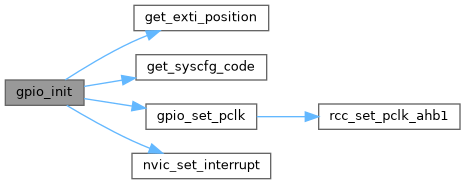
Here is the call graph for this function:
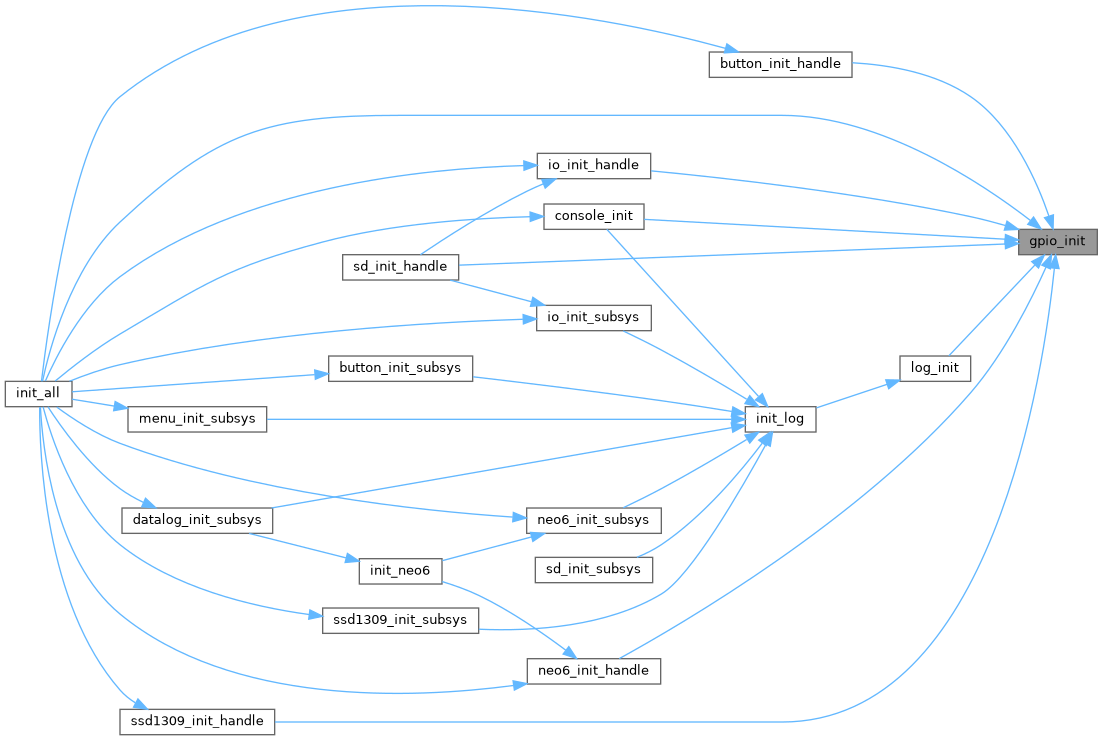
Here is the caller graph for this function:
◆ gpio_deinit()
| void gpio_deinit | ( | GPIO_REGDEF_ts const * | gpio_port | ) |
Deinitializes a GPIO port by resetting its registers to reset values.
- See also
- gpio_deinit
Definition at line 103 of file stm32f401re_gpio.c.
103 {
106 }
109 }
112 }
115 }
118 }
121 }
122
124}
void rcc_reset_periph_ahb1(RCC_AHB1RSTR_te periph_position)
Resets an AHB1 peripheral via RCC_AHB1RSTR.
Definition stm32f401re_rcc.c:117
Here is the call graph for this function:

◆ gpio_write()
| void gpio_write | ( | GPIO_REGDEF_ts * | gpio_port, |
| uint8_t | gpio_pin, | ||
| PIN_STATUS_te | pin_status ) |
Drives a GPIO output pin high or low.
- See also
- gpio_write
Definition at line 127 of file stm32f401re_gpio.c.
127 {
128 switch(pin_status) {
130 gpio_port->GPIO_ODR |= (0x1 << gpio_pin);
131 break;
133 gpio_port->GPIO_ODR &= ~(0x1 << gpio_pin);
134 break;
135 }
136}
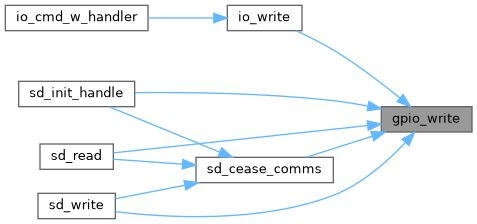
Here is the caller graph for this function:
◆ gpio_read()
| PIN_STATUS_te gpio_read | ( | GPIO_REGDEF_ts const * | gpio_port, |
| uint8_t | gpio_pin ) |
Reads the current logic level of a GPIO input pin.
- See also
- gpio_read
Definition at line 139 of file stm32f401re_gpio.c.
Here is the caller graph for this function:

◆ gpio_clear_interrupt()
| void gpio_clear_interrupt | ( | EXTI_LINES_te | exti_line | ) |
Clears the EXTI pending flag for the given interrupt line.
- See also
- gpio_clear_interrupt
Definition at line 145 of file stm32f401re_gpio.c.
◆ gpio_get_name()
| void gpio_get_name | ( | GPIO_REGDEF_ts const * | gpio_port, |
| char * | name ) |
Returns the name string of a GPIO port.
Returns the name string of a GPIO port (e.g. "GPIOA").
- See also
- gpio_get_name
Definition at line 150 of file stm32f401re_gpio.c.
150 {
151 const char gpio[] = "GPIO";
152 uint8_t gpio_len = get_str_len(gpio);
153 uint8_t pos_counter = 0;
154
155 while(pos_counter < gpio_len) {
156 name[pos_counter] = gpio[pos_counter];
157 pos_counter++;
158 }
159
166 pos_counter++;
167
168 name[pos_counter] = '\0';
169}
uint32_t get_str_len(char const *str)
Returns the length of a string, excluding the null terminator.
Definition common.c:22
Here is the call graph for this function: