Loading...
Searching...
No Matches
USART Internal Helpers
Functions | |
| static void | usart_set_pclk (USART_REGDEF_ts const *instance, EN_STATUS_te en_status) |
| Enables or disables the peripheral clock for a USART instance. | |
| static void | usart_set_baud_rate (USART_CFG_ts *usart_cfg) |
| Computes and writes the BRR register for the configured baud rate. | |
Detailed Description
Function Documentation
◆ usart_set_pclk()
|
static |
Enables or disables the peripheral clock for a USART instance.
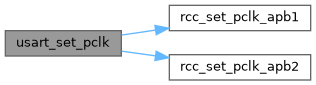
Routes to the appropriate RCC APB1 or APB2 clock enable/disable call:
- USART1 and USART6 are on APB2.
- USART2 is on APB1.
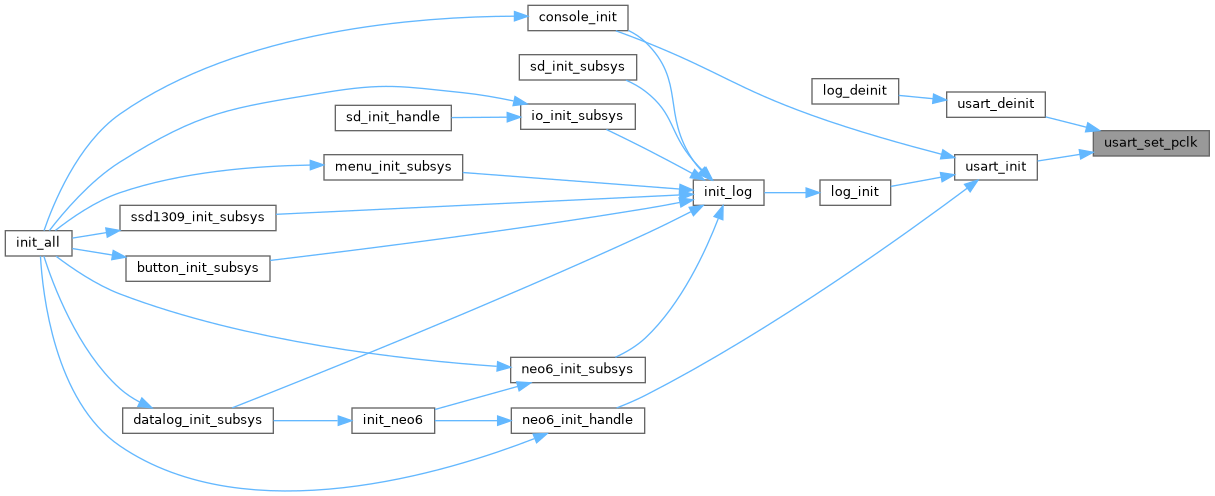
Called by usart_init and usart_deinit.
- Parameters
-
[in] instance Pointer to the USART peripheral instance. [in] en_status ENABLE to enable the clock, DISABLE to disable it.
Definition at line 183 of file stm32f401re_usart.c.
183 {
186 }
189 }
192 }
193}
void rcc_set_pclk_apb2(RCC_APB2ENR_te periph_position, EN_STATUS_te en_status)
Enables or disables the peripheral clock for an APB2 peripheral.
Definition stm32f401re_rcc.c:107
void rcc_set_pclk_apb1(RCC_APB1ENR_te periph_position, EN_STATUS_te en_status)
Enables or disables the peripheral clock for an APB1 peripheral.
Definition stm32f401re_rcc.c:97
Here is the call graph for this function:
Here is the caller graph for this function:
◆ usart_set_baud_rate()
|
static |
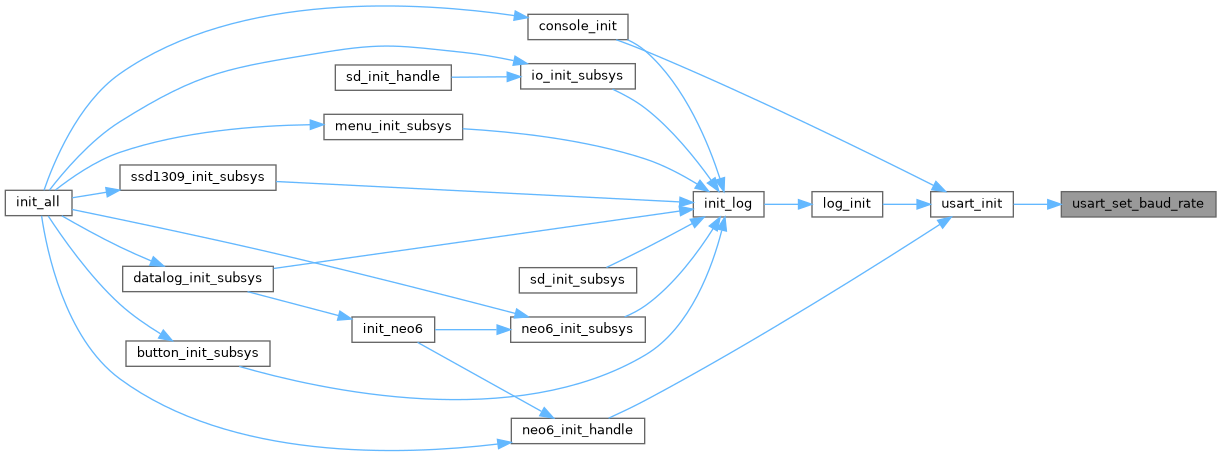
Computes and writes the BRR register for the configured baud rate.
Uses the fixed-point scaling method from the STM32 reference manual:
- USARTDIV × 100 = (25 × PCLK) / (multiplier × baud_rate), where multiplier is 2 for OVER8 and 4 for OVER16.
- The mantissa is USARTDIV / 100.
- The fraction is rounded and masked to 3 bits (OVER8) or 4 bits (OVER16).
USART1 and USART6 use the APB2 clock; USART2 uses the APB1 clock.
- Parameters
-
[in] usart_cfg Pointer to the USART configuration structure.
Definition at line 209 of file stm32f401re_usart.c.
209 {
211 uint32_t usart_pclk = 0;
212 uint32_t temp_reg = 0;
213 uint32_t usartdiv = 0;
214 uint32_t usartdiv_mantissa;
215 uint32_t usartdiv_fraction;
216
218 usart_pclk = rcc_get_apb2_clk();
219 }
221 usart_pclk = rcc_get_apb1_clk();
222 }
223
225 usartdiv = ((25 * usart_pclk) / (2 * usart_cfg->baud_rate));
226 }
228 usartdiv = ((25 * usart_pclk) / (4 * usart_cfg->baud_rate));
229 }
230
231 usartdiv_mantissa = usartdiv / 100;
232 temp_reg |= usartdiv_mantissa << 4;
233
234 usartdiv_fraction = (usartdiv - (usartdiv_mantissa * 100));
235
237 // Round fraction to 3 bits for OVER8
238 usartdiv_fraction = (((usartdiv_fraction * 8) + 50) / 100) & ((uint8_t)0x07);
239 }
241 // Round fraction to 4 bits for OVER16
242 usartdiv_fraction = (((usartdiv_fraction * 16) + 50) / 100) & ((uint8_t)0x0F);
243 }
244
245 temp_reg |= usartdiv_fraction;
247}
uint32_t rcc_get_apb2_clk(void)
Returns the current APB2 (high-speed) peripheral bus clock frequency in Hz.
Definition stm32f401re_rcc.c:71
uint32_t rcc_get_apb1_clk(void)
Returns the current APB1 (low-speed) peripheral bus clock frequency in Hz.
Definition stm32f401re_rcc.c:55
Here is the call graph for this function:

Here is the caller graph for this function: