Loading...
Searching...
No Matches
Log Public APIs
Functions | |
| ERR_te | log_init (LOG_HANDLE_ts *log_handle) |
| Initializes the log subsystem. | |
| ERR_te | log_deinit () |
| Deinitializes the log subsystem. | |
| ERR_te | log_print (MODULES_te subsys, LOG_LEVEL_te subsys_log_level, LOG_LEVEL_te log_level, char *msg,...) |
| Prints a formatted message to the serial terminal if the severity threshold is met. | |
| ERR_te | log_get_level_name (LOG_LEVEL_te log_level, char *str) |
| Converts a LOG_LEVEL_te value to its lowercase string name. | |
| ERR_te | log_level_to_int (char const *str, LOG_LEVEL_te *log_level) |
| Converts a log level name string to its LOG_LEVEL_te value. | |
| ERR_te | log_set_force_disable (bool bool_status) |
| Enables or disables forced suppression of all log output. | |
Detailed Description
Function Documentation
◆ log_init()
| ERR_te log_init | ( | LOG_HANDLE_ts * | log_handle | ) |
Initializes the log subsystem.
- See also
- log_init
Definition at line 56 of file log.c.
56 {
59 }
60
62
63 init_rtc();
64
65 GPIO_CFG_ts log_tx_pin = { 0 };
70 gpio_init(&log_tx_pin);
71
72 USART_CFG_ts log_usart = { 0 };
75 usart_init(&log_usart);
76
78
80
82}
static struct internal_state_s internal_state
Singleton instance of the SysTick driver internal state.
Definition arm_cortex_m4_systick.c:33
ERR_te init_rtc(void)
Initializes the RTC peripheral and sets a default calendar and time.
Definition init.c:72
void gpio_init(GPIO_CFG_ts *gpio_cfg)
Initializes a GPIO pin according to the given configuration.
Definition stm32f401re_gpio.c:29
void usart_init(USART_CFG_ts *usart_cfg)
Initializes the USART peripheral with the given configuration.
Definition stm32f401re_usart.c:28
void usart_set_transmission(USART_REGDEF_ts *usart_instance, EN_STATUS_te en_status)
Enables or disables the USART transmitter (TE bit).
Definition stm32f401re_usart.c:133
GPIO_ALTERNATE_FUNCTION_te alternate_function
Definition stm32f401re_gpio.h:188
GPIO_ALTERNATE_FUNCTION_te gpio_alternate_function
Definition log.h:94
Configuration structure for initializing a USART peripheral.
Definition stm32f401re_usart.h:160
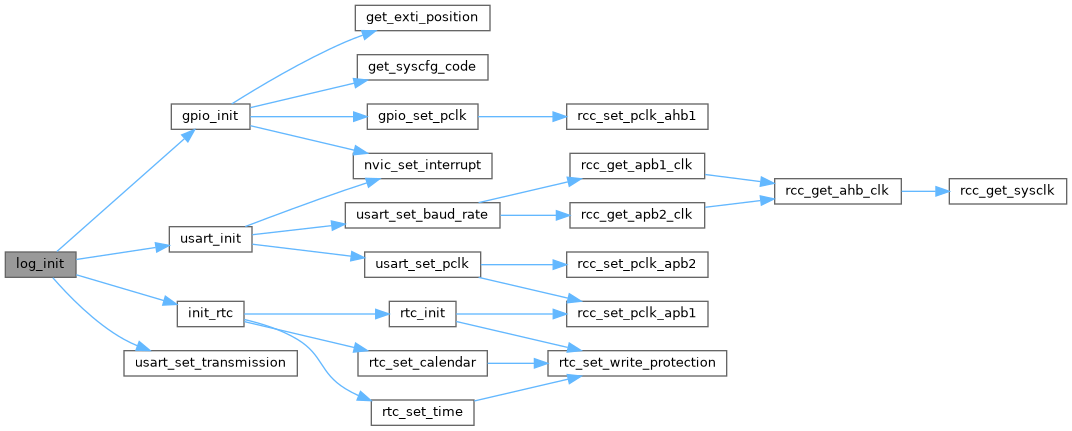
Here is the call graph for this function:
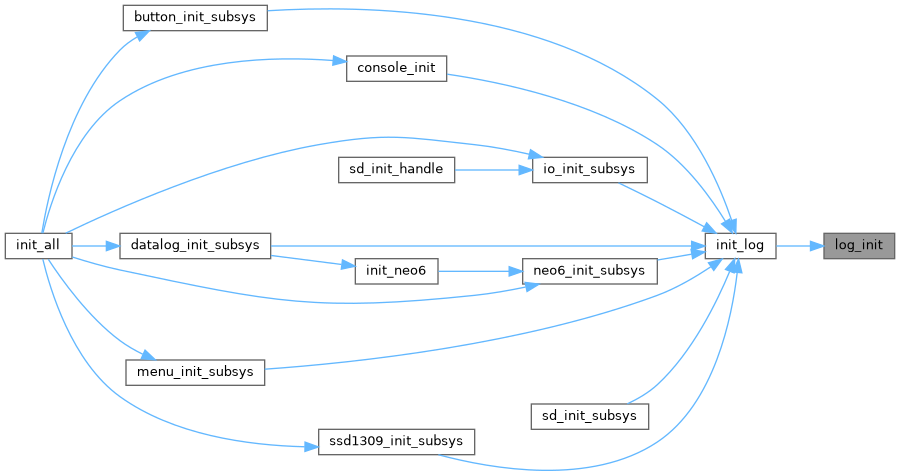
Here is the caller graph for this function:
◆ log_deinit()
| ERR_te log_deinit | ( | void | ) |
Deinitializes the log subsystem.
- See also
- log_deinit
Definition at line 85 of file log.c.
85 {
88 }
89
91
92 internal_state.usart_instance = 0;
93 internal_state.force_disable = 0;
94
96}
void usart_deinit(USART_REGDEF_ts const *usart_instance)
Deinitializes the USART peripheral, disables its NVIC interrupt, and disables its clock.
Definition stm32f401re_usart.c:93
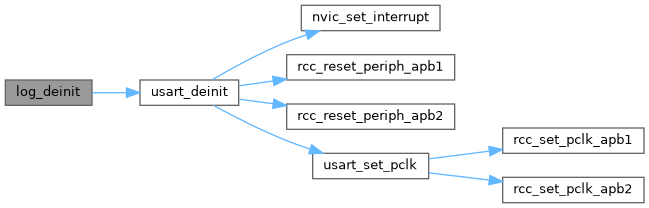
Here is the call graph for this function:
◆ log_print()
| ERR_te log_print | ( | MODULES_te | subsys, |
| LOG_LEVEL_te | subsys_log_level, | ||
| LOG_LEVEL_te | log_level, | ||
| char * | msg, | ||
| ... ) |
Prints a formatted message to the serial terminal if the severity threshold is met.
- See also
- log_print
Definition at line 99 of file log.c.
99 {
101 va_list args;
102 va_start(args, msg);
103
104 log_print_prologue(subsys, log_level);
105
106 while (*msg != '\0') {
107 if (*msg == '%') {
108 msg++;
109
110 if (*msg == 'd') {
111 int32_t num = va_arg(args, int);
112 char num_buf[12];
113 int_to_str(num, num_buf);
115 }
116 else if (*msg == 's') {
117 char *str = va_arg(args, char*);
119 }
120 else if(*msg == '.') {
121 msg++;
122
123 char dec_places_str[2];
124 dec_places_str[0] = *msg; // There can be no more than 9 decimal places
125 dec_places_str[1] = '\0';
126
127 msg++;
128
129 if(*msg == 'f') {
130 double num = va_arg(args, double);
131 char num_buf[20] = { 0 };
134 }
135 }
136 }
137 else {
139 }
140
141 msg++;
142 }
143
144 va_end(args);
145
147 }
148
150}
uint32_t get_str_len(char const *str)
Returns the length of a string, excluding the null terminator.
Definition common.c:22
void double_to_str(double num, char *str, int8_t frac_digits)
Converts a double to a decimal string with a fixed number of fractional digits.
Definition common.c:102
void int_to_str(int num, char *str)
Converts an integer to its decimal string representation.
Definition common.c:33
static ERR_te log_print_prologue(MODULES_te subsys, LOG_LEVEL_te log_level)
Prints the log message prologue: timestamp, severity, and subsystem name.
Definition log.c:248
void usart_send(USART_REGDEF_ts *usart_instance, uint8_t *tx_buffer, uint32_t len)
Blocking USART transmit. Sends len bytes from tx_buffer.
Definition stm32f401re_usart.c:111
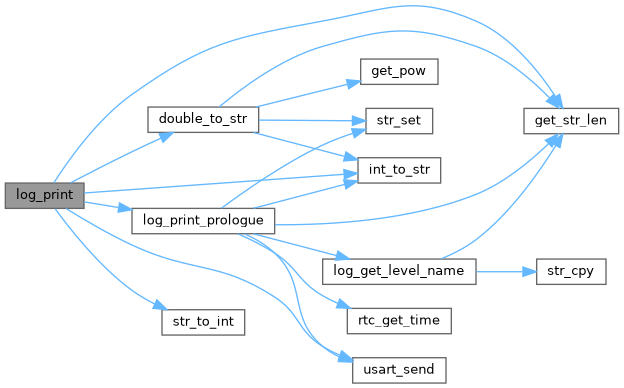
Here is the call graph for this function:
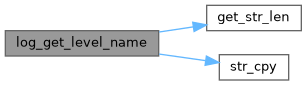
◆ log_get_level_name()
| ERR_te log_get_level_name | ( | LOG_LEVEL_te | log_level, |
| char * | str ) |
Converts a LOG_LEVEL_te value to its lowercase string name.
- See also
- log_get_level_name
Definition at line 153 of file log.c.
153 {
154 char const *name;
155
156 switch(log_level) {
158 name = "none";
159 break;
160
162 name = "info";
163 break;
164
166 name = "debug";
167 break;
168
170 name = "warning";
171 break;
172
174 name = "error";
175 break;
176
178 name = "critical";
179 break;
180
181 default:
183 break;
184 }
185
187
189}
int str_cpy(char *str_to, const char *str_from, uint32_t len)
Copies a null-terminated string into a destination buffer.
Definition common.c:333
Here is the call graph for this function:
Here is the caller graph for this function:

◆ log_level_to_int()
| ERR_te log_level_to_int | ( | char const * | str, |
| LOG_LEVEL_te * | log_level ) |
Converts a log level name string to its LOG_LEVEL_te value.
- See also
- log_level_to_int
Definition at line 192 of file log.c.
192 {
194 *log_level = LOG_LEVEL_NONE;
195 }
197 *log_level = LOG_LEVEL_INFO;
198 }
200 *log_level = LOG_LEVEL_DEBUG;
201 }
203 *log_level = LOG_LEVEL_WARNING;
204 }
206 *log_level = LOG_LEVEL_ERROR;
207 }
209 *log_level = LOG_LEVEL_CRITICAL;
210 }
211 else {
212 *log_level = LOG_LEVEL_NONE;
213 }
214
216}
bool str_cmp(const char *str1, const char *str2)
Compares two null-terminated strings for equality.
Definition common.c:248
Here is the call graph for this function:

Here is the caller graph for this function:

◆ log_set_force_disable()
| ERR_te log_set_force_disable | ( | bool | bool_status | ) |
Enables or disables forced suppression of all log output.
- See also
- log_set_force_disable
Definition at line 219 of file log.c.
Here is the caller graph for this function: